
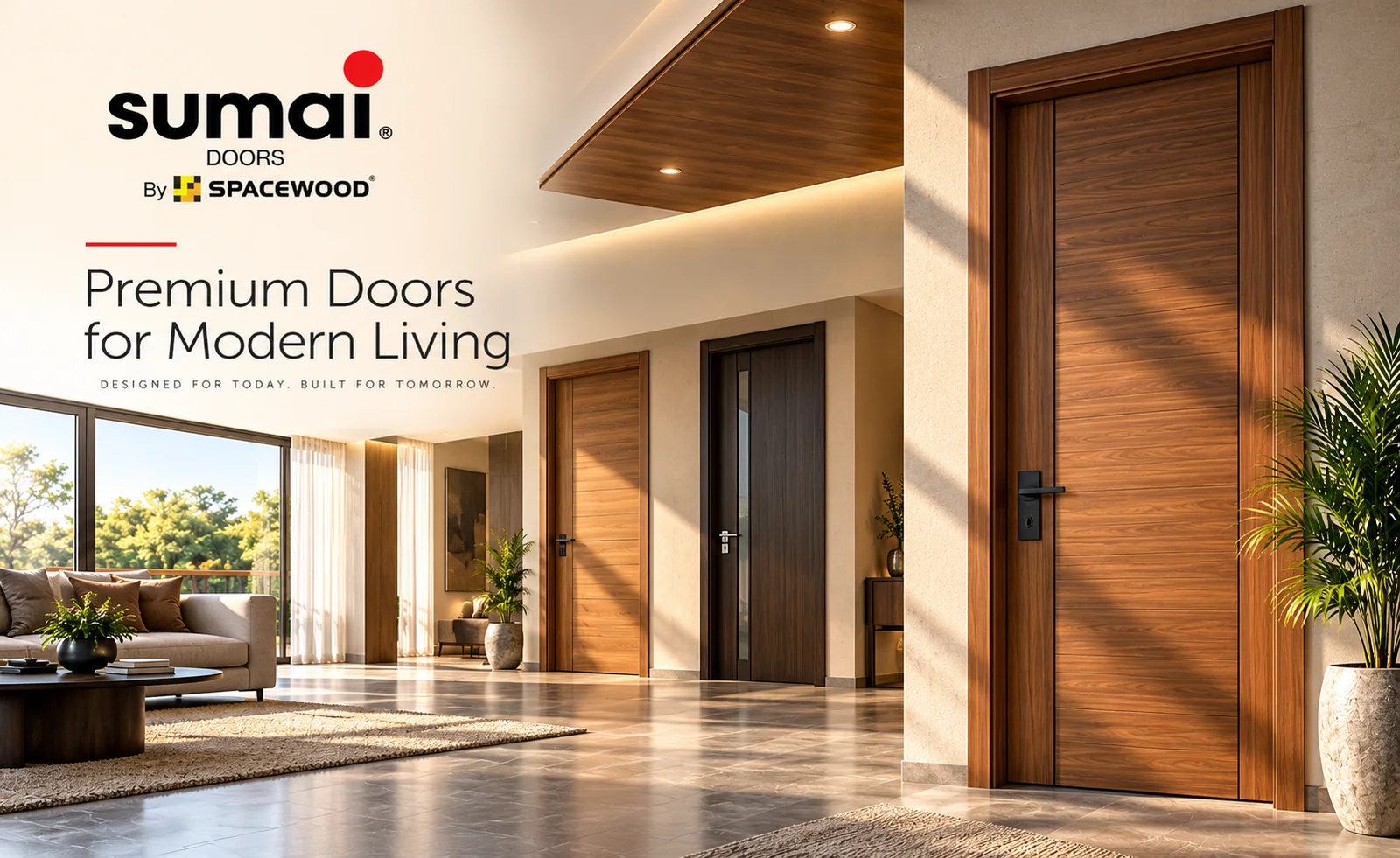
Not Just a Door Shutter—A Complete Door Solution
When people purchase a conventional door shutter, they may still need to separately arrange the frame, architrave, laminate or veneer, polishing, hinges, lock preparation and site carpentry. Differences in measurement, material and workmanship can affect the final appearance and operation of the door.
Sumai Doors by Spacewood approaches the requirement as a coordinated doorset. The door panel, frame, architrave and hardware provisions can be planned as one system and factory-finished for better visual consistency.
This approach is particularly useful for apartments, villas, hotels, offices, institutions and large residential developments where repeatable quality, controlled finishing and installation planning are important.
Engineered by Spacewood, Manufactured with Precision
Sumai Doors is a brand from Spacewood, an Indian manufacturing group with approximately three decades of experience in furniture and interior solutions.
The Sumai manufacturing facility uses automated machinery and Japanese manufacturing technology for door processing and finishing. The company publishes production capability of up to approximately 900 door sets per day, supporting both individual residential requirements and large project quantities.
Key brand strengths
- Spacewood’s manufacturing background
- Factory-controlled production
- Automated and precision-oriented machinery
- Pre-hung door system capability
- Engineered wooden door construction
- Consistent finishes across multiple doors
- Residential and commercial project suitability
- Published IS and environmental certification credentials
Manufacturing capacity, testing, warranty and certification statements are as published by the manufacturer and should be confirmed for the applicable Sumai product in current documentation.
What Can a Sumai Pre-Hung Door Set Include?
- Factory-finished engineered door panel
- Matching or coordinated door frame
- Architrave
- Hinge preparation
- Lock and hardware preparation
- Controlled edge finishing
- Selected surface finish
- Application-specific core and construction
- Installation-ready component coordination
The precise inclusions depend on the selected model, application, size and hardware specification. The quotation must clearly mention everything included in the chosen doorset.
Important customer benefit: with conventional doors, different contractors may handle the shutter, frame, finishing and hardware. A coordinated pre-hung system can reduce these interfaces and help achieve a more uniform result.
Door Solutions for Different Areas
Interior Doors
Engineered doors for bedrooms, passages, studies and other internal areas where appearance, smooth operation and finish consistency are important.
Main Entrance and Living-Area Doors
Selected configurations intended for prominent residential openings. The construction, security hardware, exposure and site conditions must be evaluated before selection.
Wet-Zone Doors
Application-specific options for suitable bathroom or utility-area entrances. A wet-zone door must be selected according to the manufacturer’s approved construction and installation guidelines. “Water-resistant” or product-specific boiling-water test results should not be interpreted as approval for continuous standing water, direct external exposure or incorrect installation.
Fire-Rated Doorsets
Fire-rated configurations may be available for suitable projects. Fire performance belongs to the tested complete assembly—including the door leaf, frame, seals, hardware and installation method. Ask for the applicable test certificate and approved configuration for the exact doorset being supplied; an ordinary Sumai door is not fire-rated.
Project Doors
Coordinated doors for apartment developments, hotels, offices, healthcare facilities, education projects and other locations requiring repeatable specifications across multiple openings.
Explore Sumai Door Collections
Classic Collection
Clean and versatile door designs suitable for contemporary homes, apartments and projects requiring a uniform visual language.
Skin Collection
Practical decorative door surfaces developed for residential and project applications.
Premium Collection
Elevated finishes and carefully coordinated surfaces for premium interiors.
Designer Collection
Distinctive patterns and visual details for customers who want the door to become part of the interior design statement.
Collections depend on current availability. Product codes, colours and finishes are confirmed from the current Sumai catalogue.
Finishes for Different Interior Styles
Japanese Olefin Finish
Olefin is a decorative synthetic surface designed to reproduce the visual character of wood while providing a consistent factory finish. It is not natural wood veneer and is not real wood.
- Consistent colour and wood-grain appearance
- Factory-controlled surface quality
- UV-stable characteristics published by the manufacturer
- No on-site polishing requirement
- Easy routine cleaning
- Multiple wood tones and textures
- Suitability for coordinated project interiors
Any durability period is a manufacturer-published performance statement, not an unconditional site guarantee.
Natural Wood Veneer
A real wood surface offering natural grain variation and an individual appearance. Veneer requires appropriate care and may show variations because it is a natural material.
PVC Membrane
A decorative surface option with different colours and patterns for selected applications.
High-Pressure Laminate
A practical decorative finish available for compatible doors and project requirements.
A Coordinated Finish Around the Entire Opening
The quality of a door depends on more than its shutter. The frame, architrave, hinges, hardware alignment and wall opening all affect its final performance. Depending on the selected system, options may include:
- Single-rebated frames
- Engineered LVL frames
- WPC architraves
- Flat architraves
- Matching decorative finishes
- Application-specific profiles
Final specifications must be based on the wall thickness, opening size, exposure, door weight, hardware and intended application.
Why Choose Sumai Doors?
- 1
Factory-Finished Consistency
The panel, frame and architrave can be finished under controlled manufacturing conditions, helping reduce variations commonly associated with manual site polishing.
- 2
Coordinated Door System
Sumai can supply a planned doorset instead of leaving the customer to coordinate several unrelated components and contractors.
- 3
Reduced Site Work
Factory finishing can reduce carpentry, polishing, dust, odour and finishing activity at the project location.
- 4
Engineered Construction
Engineered materials are designed to provide controlled dimensions and repeatable performance when the correct product is selected, stored and installed properly.
- 5
Design Choices
Olefin, veneer, membrane and laminate options allow doors to be coordinated with different interior concepts and budgets.
- 6
Project-Scale Capability
Manufacturing capacity and repeatable specifications make the system suitable for developers, hospitality projects, offices and institutional requirements.
- 7
Documented Product Standards
Sumai publishes conformity and testing information for selected products, including references to IS 2202, IS 4020 and GreenPro certification. Certifications should always be verified against the exact product supplied.
- 8
Cleaner Handover
Reduced site polishing and better component coordination can contribute to cleaner installation and more predictable project completion.
How Sumai Differs from Other Door-Buying Options
Sumai pre-hung doors versus a standard flush-door shutter
A flush-door shutter may be economical, but the customer normally needs to coordinate the frame, finish, hardware preparation, architrave and installation separately.
Sumai’s pre-hung approach is designed to coordinate these components as a system.
Sumai versus carpenter-made doors
Carpenter-made doors offer customisation and traditional craftsmanship. However, final quality can depend heavily on timber condition, carpenter skill, site measurement, polishing and weather during installation.
Sumai offers factory-controlled production and greater repeatability across multiple openings.
Sumai versus solid-wood doors
Solid wood provides natural character and can be restored by skilled craftsmen. It may also respond to humidity, seasonal movement and site conditions and can require regular care.
An engineered door system is intended to provide more controlled and consistent project execution. The correct choice depends on the desired appearance, exposure and maintenance expectations.
Sumai versus steel doors
Steel entrance doors can offer strong security and weather resistance in approved configurations. However, steel and engineered wooden doors belong to different material and design categories.
Customers should compare security hardware, exposure, thermal behaviour, sound performance, maintenance and interior aesthetics—not only the appearance.
Sumai versus aluminium or uPVC doors
Aluminium and uPVC can be appropriate for external, balcony or wet-area openings. Sumai engineered wooden doors are primarily selected where a warm interior appearance and coordinated wooden doorset are desired.
The application should determine the material.
Customers considering Sumai may also evaluate
- Other branded engineered door and frame manufacturers
- Branded flush doors from national plywood and panel companies
- Imported European wooden door systems
- Branded steel entrance doors
- Regional flush-door manufacturers
- Local carpenter-made wooden doors
- Other pre-hung engineered doorset manufacturers
Compare on these points
- Doorset completeness
- Factory finish
- Frame and architrave coordination
- Core construction
- Surface material
- Tested performance
- Hardware preparation
- Installation responsibility
- Warranty terms
- After-sales process
- Total installed cost
Do Not Compare Only the Shutter Price
Ask every supplier:
- Is the quotation for only the shutter or the complete doorset?
- Are the frame and architrave included?
- Is the finish factory-applied or completed at the site?
- What core construction is used?
- What substrate is used beneath the decorative surface?
- Is the surface Olefin, laminate, veneer, membrane or paint?
- Is hardware preparation included?
- Which hinges and locks are compatible?
- Who measures and approves the wall opening?
- Who is responsible for installation?
- What opening tolerances must the civil contractor maintain?
- Is the selected door approved for bathrooms or wet areas?
- Is it suitable for direct rain or exterior exposure?
- If it is described as fire-rated, is the entire assembly tested?
- Can the supplier produce the relevant test certificate?
- What does the warranty cover and exclude?
- How will transit or installation damage be handled?
- Can replacement hardware and matching finishes be obtained later?
- What maintenance does the door require?
- What is the total installed cost after adding the frame, hardware, finishing and labour?
Who Should Consider Sumai?
Homeowners
For homeowners seeking modern wooden doors with consistent finishes and reduced on-site polishing work.
Architects and Interior Designers
For professionals who require coordinated design, defined surface specifications and repeatability across several openings.
Builders and Developers
For projects requiring scalable production, predictable door schedules and consistent appearance across multiple apartments or rooms.
Hotels and Commercial Projects
For properties where standardised specifications, installation planning and finish coordination are important.
Healthcare and Educational Projects
For application-specific doors where specification control and documentation are critical. Fire, acoustic, hygiene and hardware requirements must be evaluated separately for every project.
From Opening Measurement to Installation
- Step 1
Understand the application
Identify whether the door is for a bedroom, bathroom entrance, main entrance, office, hotel room or a fire-rated opening.
- Step 2
Inspect the site opening
Measure the width, height, wall thickness, floor level, squareness and surrounding conditions.
- Step 3
Select the construction
Choose the suitable door core, thickness, frame, architrave and application category.
- Step 4
Select the finish
Choose Olefin, veneer, membrane or laminate according to the design, budget and maintenance expectations.
- Step 5
Finalise hardware
Confirm hinges, locks, handles, door closers, seals and access-control requirements.
- Step 6
Approve the specification
Confirm door handing, opening direction, sizes, design codes, quantities and project schedule before manufacturing.
- Step 7
Factory production
The selected door components are manufactured and finished according to the approved order.
- Step 8
Installation and handover
Install the doorset according to the manufacturer’s requirements, inspect alignment and operation, and provide care instructions.
Product specifications, finishes and availability may change. Final selection is subject to the current manufacturer catalogue and approved technical documentation.